
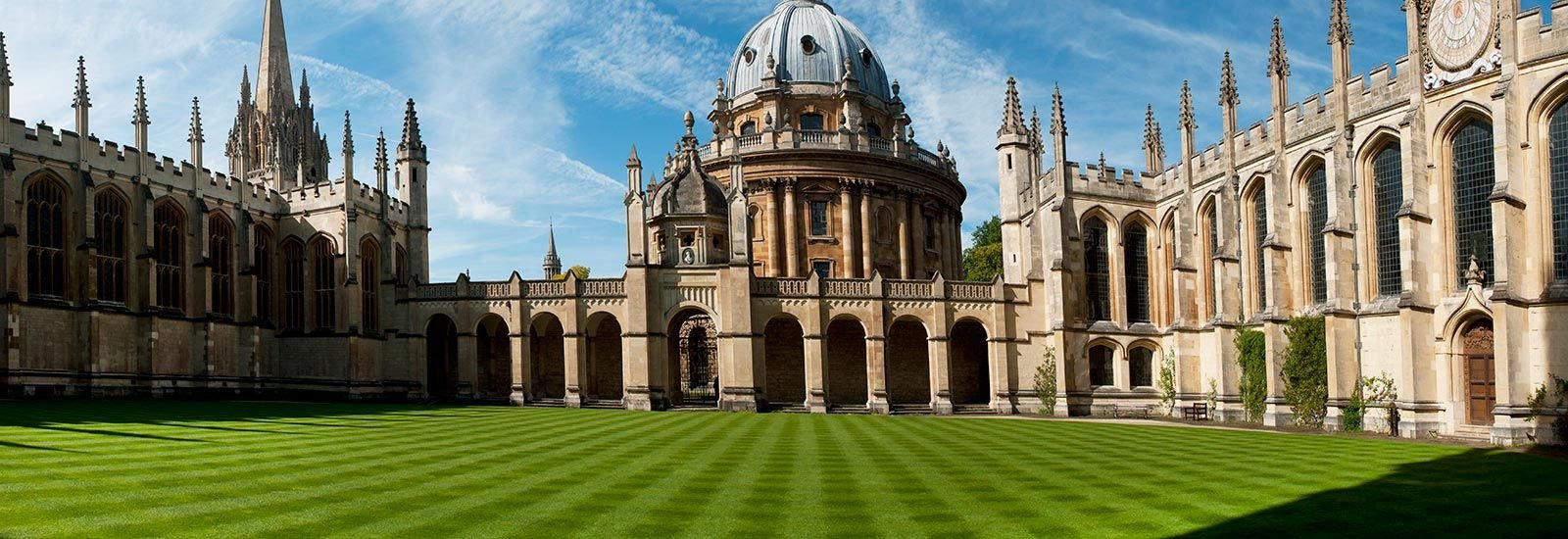
University of Oxford Summary
The University of Oxford’s founding date isn’t precisely known, but its history stretches back to at least 1096. Situated about 60 miles northwest of London, Oxford has a student body where graduate students make up roughly 45%. Over half of these graduate students are involved in research as part of their studies. Research at Oxford spans all four of its academic divisions: humanities; mathematical, physical, and life sciences; medical sciences; and social sciences. The academic year is split into three terms—Michaelmas (fall), Hilary (spring), and Trinity (summer)—each lasting eight weeks. English is the language of instruction.
Oxford University consists of a central university, 38 colleges, and six Permanent Private Halls (which are smaller than colleges and offer fewer subjects). Each college has its own dining hall, common room, and library. First-year undergrads are guaranteed housing within their college and often have the option to stay there in later years. While grad students aren’t guaranteed housing, some colleges may accommodate them in their first year, particularly international students. Tuition fees are higher for non-European Union students. The university, along with its departments, colleges, and numerous external organizations, offers over 900 scholarships for graduate students.
University of Oxford Rankings
The University of Oxford ranks #4 in Best Global Universities, based on widely accepted indicators of academic excellence.
Global Rankings:
- #4 – Best Global Universities
- #1 – Best Global Universities in Europe
- #1 – Best Global Universities in the United Kingdom
Subject Rankings:
- #131 – Agricultural Sciences (tie)
- #20 – Artificial Intelligence
- #1 – Arts and Humanities
- #8 – Biology and Biochemistry
- #31 – Biotechnology and Applied Microbiology
- #15 – Cardiac and Cardiovascular Systems (tie)
- #10 – Cell Biology
- #129 – Chemical Engineering
- #35 – Chemistry (tie)
- #9 – Clinical Medicine
- #18 – Computer Science
- #71 – Condensed Matter Physics
- #4 – Ecology
- #15 – Economics and Business (tie)
- #9 – Education and Educational Research
- #110 – Electrical and Electronic Engineering
- #6 – Endocrinology and Metabolism
- #57 – Energy and Fuels
- #73 – Engineering (tie)
- #9 – Environment/Ecology
- #13 – Gastroenterology and Hepatology
- #17 – Geosciences
- #65 – Green and Sustainable Science and Technology (tie)
- #11 – Immunology
- #1 – Infectious Diseases
- #64 – Materials Science
- #4 – Mathematics
- #144 – Mechanical Engineering (tie)
- #23 – Meteorology and Atmospheric Sciences
- #2 – Microbiology
- #7 – Molecular Biology and Genetics
- #135 – Nanoscience and Nanotechnology (tie)
- #10 – Neuroscience and Behavior
- #51 – Oncology
- #30 – Optics (tie)
- #27 – Pharmacology and Toxicology
- #85 – Physical Chemistry
- #13 – Physics
- #40 – Plant and Animal Science (tie)
- #3 – Psychiatry/Psychology
- #4 – Public, Environmental and Occupational Health
- #13 – Radiology, Nuclear Medicine and Medical Imaging
- #2 – Social Sciences and Public Health
- #14 – Space Science
- #32 – Surgery
- #48 – Water Resources
2024-2025 Indicator Rankings
Oxford’s #4 global ranking is based on 13 performance indicators:
- Global Score: 88.2
- Global Research Reputation: #5
- Regional Research Reputation: #12
- Publications: #8
- Books: #1
- Conferences: #54
- Normalized Citation Impact: #57
- Total Citations: #5
- Top 10% Most Cited Publications: #6
- Percentage of Top 10% Most Cited Publications: #48
- International Collaboration (Relative to Country): #561
- International Collaboration: #257
- Top 1% Most Cited Papers: #6
- Percentage of Top 1% Most Cited Papers: #79